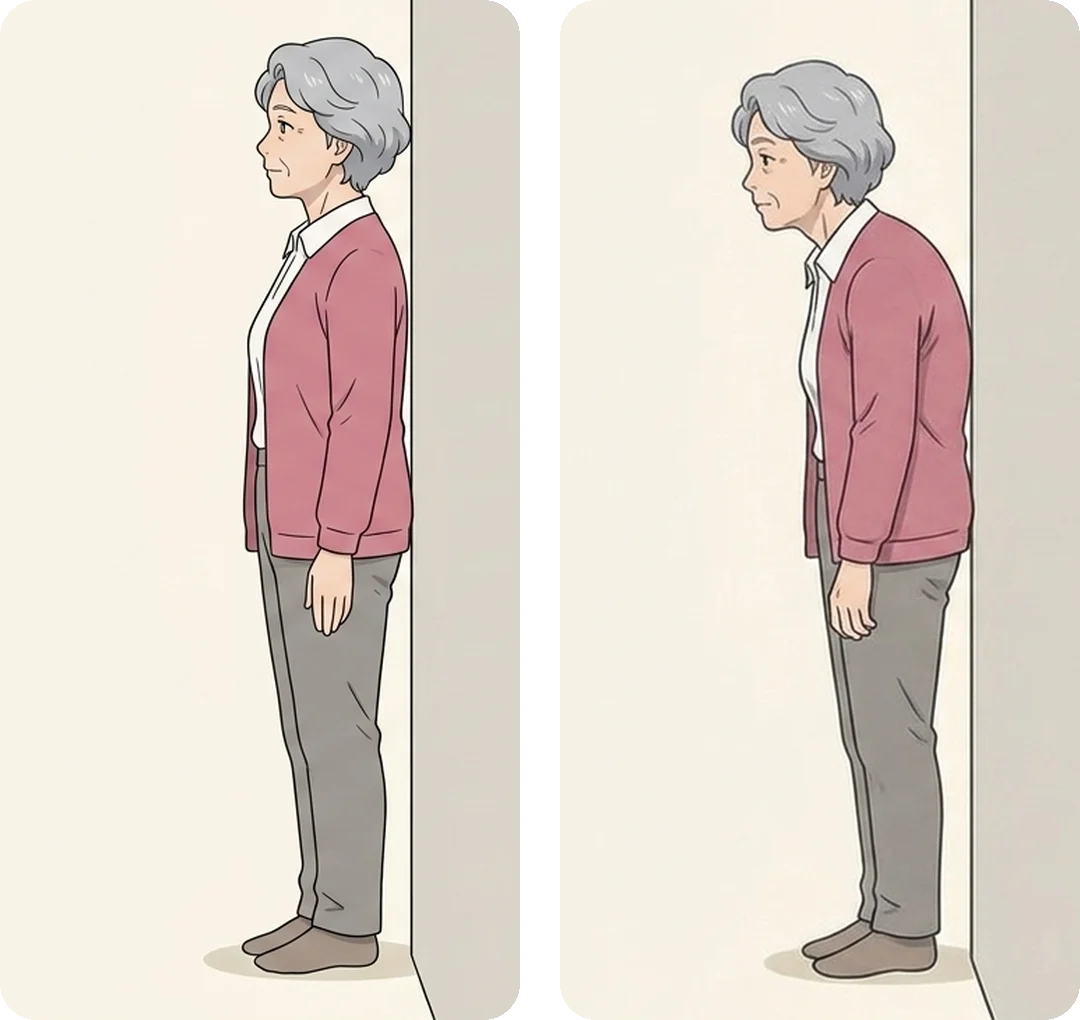
Kasukawa Y, et al. Age-related changes in muscle strength and spinal kyphosis angles in an elderly Japanese population. Clin Interv Aging. 2017;12:413-20. PMID: 28260870(秋田、50歳以上の男性252人・女性320人の横断研究。握力・背筋力・股関節と膝の筋力は男女とも加齢で低下。背筋力と胸椎の丸まりが、腰椎の丸まりに関わる因子だった)
Miyakoshi N, et al. Back extensor strength and lumbar spinal mobility are predictors of quality of life in patients with postmenopausal osteoporosis. Osteoporos Int. 2007;18:1397-403. PMID: 17460805(閉経後骨粗鬆症の女性174人・平均68歳の横断研究。日本骨粗鬆症QOL質問票と最も強く相関したのは背筋力〔r=0.455〕。骨密度は r=0.16〜0.20。多変量解析で背筋力と腰椎の可動性が有意な因子)
Muramoto A, et al. Spinal sagittal balance substantially influences locomotive syndrome and physical performance in community-living middle-aged and elderly women. J Orthop Sci. 2016;21:216-21. PMID: 26806334(八雲町の女性125人・40〜88歳の横断研究。体の前傾が6°以上の人は、ロコモに当てはまるオッズが5.0倍。歩行・片脚立ちなども不良)
Kado DM, et al. Hyperkyphotic posture and risk of injurious falls in older persons: the Rancho Bernardo Study. J Gerontol A Biol Sci Med Sci. 2007;62:652-7. PMID: 17595423(1,883人。背中の丸い人は、けがをする転倒のオッズが1.38倍。男性でより強い関連)
McDaniels-Davidson C, et al. Kyphosis and incident falls among community-dwelling older adults. Osteoporos Int. 2018;29:163-9. PMID: 29018904(65歳以上72人の前向き研究。丸まりが1標準偏差強いごとに、1年間の転倒のオッズが2倍以上。小規模)
Kado DM, et al. Hyperkyphosis predicts mortality independent of vertebral osteoporosis in older women. Ann Intern Med. 2009;150:681-7. PMID: 19451575(女性610人・平均13.5年の追跡。丸まりが強いほど死亡の危険が高く〔1標準偏差あたり1.15倍〕、とくに椎体骨折のある女性で強かった。観察研究)
Cours A, et al. Hyperkyphosis and mortality risk in older men: the osteoporotic fractures in men study. J Am Geriatr Soc. 2023;71:496-504. PMID: 36307923(男性2,931人・平均8.3年。丸まりが強いほど死亡の危険が高かった〔1.26〜1.53倍〕。レントゲンの角度では関連なし。観察研究)
Green AD, et al. Does this woman have osteoporosis? JAMA. 2004;292:2890-900. PMID: 15598921(身体診察の系統的レビュー。後頭部と壁の距離が0 cmを超える〔陽性尤度比4.6〕、肋骨と骨盤の距離が指2本分未満〔同3.8〕は、気づかれていない椎体骨折を示唆。単独では確定も否定もできない)
Hongo M, et al. Effect of low-intensity back exercise on quality of life and back extensor strength in patients with osteoporosis: a randomized controlled trial. Osteoporos Int. 2007;18:1389-95. PMID: 17572835(秋田、骨粗鬆症の閉経後女性80人のランダム化比較試験。うつぶせから上体を起こして水平に保つ家庭での運動。4か月で背筋力 +26%〔対照 +11%〕、QOL +7%〔対照 0%〕、QOLに群間差あり)
Katzman WB, et al. Targeted spine strengthening exercise and posture training program to reduce hyperkyphosis in older adults: results from the SHEAF randomized controlled trial. Osteoporos Int. 2017;28:2831-41. PMID: 28689306(60歳以上・丸まり40°以上の99人。理学療法士の指導で週3回・6か月。丸まりの角度が対照より3.0°改善、自己イメージも改善。体の動きには差なし)
Ponzano M, et al. Exercise for improving age-related hyperkyphosis: a systematic review and meta-analysis with GRADE assessment. Arch Osteoporos. 2021;16:140. PMID: 34546447(24研究。運動で丸まりが改善〔中等度の確かさ〕、QOLも改善〔中等度〕。転倒が減るかは不明〔低い確かさ〕。重い有害事象の報告なし)
Sinaki M, et al. Stronger back muscles reduce the incidence of vertebral fractures: a prospective 10 year follow-up of postmenopausal women. Bone. 2002;30:836-41. PMID: 12052450(2年間の背筋運動のランダム化試験に参加した50人を10年後に追跡。椎体骨折は運動群1.6%・対照群4.3%。小規模)
Giangregorio LM, et al. Too Fit To Fracture: exercise recommendations for individuals with osteoporosis or osteoporotic vertebral fracture. Osteoporos Int. 2014;25:821-35. / Brooke-Wavell K, et al. Strong, steady and straight: UK consensus statement on physical activity and exercise for osteoporosis. Br J Sports Med. 2022;56:837-46.(背中を伸ばす筋の運動を推奨。椎体骨折のある人は専門職と相談しながら)